The Murder of Carolina Striegel Kaelin, August 7, 1885
At about 10:30 a.m., on the morning of August 7, 1885, Mr. Christopher Schneider, a German, was working outside his Portland home. (At the time, it was quite common to identify people by their ethnic or national origin.) A little boy, the child of a neighbor, leaned over the fence separating them and called to him.
“Oh come and help us, papa has killed poor mama – help, help,” he shrieked.
The child, only five years old, appeared shocked and terrified, and gestured excitedly to Schneider. Schneider dropped the hoe with which he had been working and ran to the Kaelin home, at Thirty-third street, between Hardin and Ash streets, just south of Bank street. At the time He dashed up the steps of the small, unpainted frame house and into the small kitchen. Finding it empty, he moved to the next room, where he was startled to find the half-dressed body of a young woman. The blood still flowed from a ghastly wound across her throat and liberally spattered her clothing, the floor and the walls. Her eyes were open in fright and shock but she was “stone dead.”
Schneider recognized her as his neighbor, Carolina Striegel Kaelin, the wife of Michael Kaelin, a dairyman. (Mrs. Kaelin’s name was variously also given as Caroline and Catherine, not unusual in a time where such details were often difficult to verify.) Schneider had seen Michael Kaelin just a few hours before, feeding his cows nearby. Schneider later claimed he ran around the woman’s body and up the stairs, looking for Kaelin, but did not find him. Schneider then dashed out to the stable, some 20 yards from the house, where he had seen Kaelin earlier.
Still, he could not find Kaelin.
Schneider ran some distance north, to Thirty-fourth and Missouri Streets, to a grocery owned by Nicholas Weisenberger, to give the “alarm of murder.” (Missouri Street no longer exists, it was north of Rudd Avenue and disappeared under the flood levee.) A number of men who were lingering near the store leaped up and followed him back to the Kaelin home.
When the men returned, they were horrified to find the children, the oldest boy outside crying, a girl of almost three with him, and inside, a child of almost two years old sitting in the room with his mother’s body, babbling, his clothing stained with her blood. A gory track of blood led up the small staircase in the room, with splotches and smears of blood on the stairs and the wall. The men shrank from going upstairs, however, believing immediately that Kaelin was the killer and might to lurking at the top of the stairs with the knife with which he’d killed his wife.
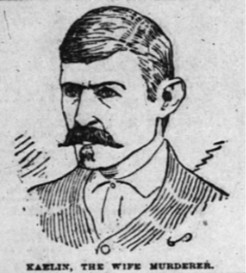
Louisville Policeman Tom Baldwin was the first officer to arrive at the scene. He entered the house and found the men huddled at the foot of the staircase. Learning what had occurred, he drew and cocked his revolver and advanced cautiously up the steps. The men crowded behind him. In the small, low-ceiling room, they found Kaelin curled up on the floor, with a wound across his neck, barely breathing. Sgt. Harrington had arrived to reinforce his officer and he immediately sent one of the men for doctors.
When Doctors Parsons and Allen arrived, they directed the assembled men to carry Kaelin downstairs. Although he did not speak, as he was lifted, he used his hands, behind his head, to hold his own head so as to close up the throat wound to slow its bleeding. Kaelin was laid down on a bed in the same room where his dead wife still lay.
The doctors found that Kaelin’s windpipe had been cut and the air was bubbling at his neck. They stitched up the gash and called for a patrol wagon to carry him to the city hospital downtown. As they waited, he raised up, saw the body of his wife nearby and collapsed back to the bed, unconscious. They searched Kaelin for the knife he had used, it was believed, on both his wife and himself, and found nothing. Finally an open pocket knife, its blade stained with blood, was found outside on the ground. It was thought that he had sliced his own thrown and then thrown the knife out window of the upstairs room, sending it sailing over the roof of the kitchen below that window, for it to fall where it was found.
The assembly of men searched the house, which was three rooms deep and a single room wide, a shotgun style house. The front room was used as a bedroom, the middle a sitting room and the rear a kitchen. Although Carolina Kaelin was found in the middle room, blood and torn clothing was found in the front bedroom and it was believed that her husband accosted her there and slit her throat. She was able then, it appeared, to run to the next room, where she collapsed and died.
Mrs. Kaelin’s mother, Mrs. Streigel, lived nearby and rushed to the scene, unsure as to what had occurred. When she learned that her daughter was the victim and was dead, she fainted, but recovered enough to come inside and sit with her daughter, rocking her back and forth in her arms and weeping.
Coroner Henry Miller arrived about 1 p.m. His first action was to finally dispatch Kaelin to the hospital, where it was thought he may not survive. Dr. Miller immediately convened a coroner’s inquest, selecting six men from among those assembled to serve as the jury. He tried to clear the house, since by that time a number of people had gathered, anxious to see the dead woman and wounded man. Michael Kaelin was no longer there but Carolina Kaelin was still lying on the floor, covered by a sheet. A ring of people, mostly women, “surrounded her and stared at the ghastly heap, while both kitchen and front room were crowded to suffocation.”
In the manner of the time, the inquest was held immediately, as soon as the jury was set, and at the scene of the death.
The first witness before the inquest, Joe Hopwood, lived at 31st and Portland Avenue. When he arrived, Carolina Kaelin’s body had already been draped and he raised the sheet to look at her. He knew Michael Kaelin pretty well from the neighborhood. Other witnesses provided more detail, that Kaelin and his wife had been married some six years and had three children, Joseph, Flora and the youngest, Charlie. Kaelin employed his brother Joe, and another man, John Kaelin, but the latter was not a relative. He had another employee reportedly named John, as well, who lived at 27th and High (Northwestern Pwy) Street. Carolina had a mother and two sisters, who also lived nearby. Kaeilin was reportedly well to do and had money in the bank, despite the meager house.
Christopher Schneider testified as to what he had witnessed, reliving the horrible scene.
Joseph Kaelin, who worked at the Portland Canal, arrived about 12:30 at the house. He immediately had the children removed to his home at 37th and High Streets. He indicated that he had not seen his brother for some six weeks, despite living only a short distance away, but that he did not consider him a drinking man. Young Joseph Kaelin was questioned but was too young to understand what he was being asked and too dazed to answer coherently.
That being all the witnesses available, the jury deliberated briefly and returned a verdict that Carolina Kaelin died from having her throat slit, at the hand of her husband.
Those in attendance thought Kaelin had killed his wife in a “fit of jealousy” and many reported that he’d beaten her, but they offered no proof. Mrs. Kaelin was reported to be a “very industrious, neat and orderly person” who was dressing to go to town at the time she was killed. She had already scoured the kitchen floor and the planks were still damp when she was killed. During the entire process, her body lay in the sitting room and exercised a “horrible fascination” for everyone there. “All crowded as near the corpse as they could get and many stepped in the blood.” The Coroner asked if anyone there could wash and dress the body but no one responded, until finally, an old woman agreed to do so if she was “well paid.” When the Coroner agreed, she “cleared the room, locked the doors and performed the task alone.”
The neighbors knew little of Kaelin but his brother thought he had loaned money out and was in a “pretty good fix.” Kaelin’s two young German employees were out with the milk wagons. It was noted that the place was on the outskirts of the city and had only scattered buildings. The house in front of Kaelin’s that faced Bank Street was occupied by Albert Unclebach, who was a barber with a business at 3300 Rudd Avenue.
At the conclusion of the inquest, Joseph Kaelin also took charge of his sister-in-law’s body and cleared the house of onlookers.
As the patrol wagon proceeded slowly to the hospital with the injured Kaelin, Officer Michaels noticed a large lump in Kaelin’s pocket. It was an old wallet containing over $500, a vast sum at the time. He turned it over to Chief John Whallen. When Kaelin arrived at the hospital, his throat had begun to swell due to the hasty stitching of his wound. The hospital doctor found it necessary to “readjust the threads” by reopening the wound. Since Kaelin was still alive, it was assumed that he would, in fact, survive. He appeared to be aware and his eyes had an “intelligent look” but he did not respond to questions.
A charge of murder was entered against Michael Kaelin, ready to be served upon him as soon as he recovered a bit.
A month later, on September 9, the time came for Kaelin’s preliminary hearing. Justice Speed Peay’s courtroom, in Court Place, was packed. Kaelin, of course, was present, surrounded by attorneys, but he was “mostly occupied with a slouch hat which rested upon his left knee.” He was unshaven and wore a dirty collar concealing his healing neck wound. He was poorly dressed in a knit shirt with the elbows out and cottonade, a heavy coarse fabric, pantaloons.
When they called for the witnesses, Mrs. Striegel was not present and it was feared a continuance would be needed. But she arrived and the Court was ready to take testimony. Coroner Miller was the first witness and described what he’d discovered at the house. He indicated that the wound in Mrs. Kaelin’s neck had severed one of the large blood vessels on the left side and that she had quickly bled to death. He agreed under cross-examination that she had been dead for some time when he arrived. He did not examine Michael Kaelin.
Patrolman Thomas Baldwin testified next and stated that the Kaelin home was on his beat. He thought Kaelin was also dead when he was found. Patrolman Baldwin made the arrest although in fact, the house was just outside the city boundary, which was Bank street at the time, and the house was south of that road. He indicated that Hopwood had gone for the doctors. In the front bedroom, Patrolman Baldwin found the bed on one side disarranged and a bundle of clothing on the other side, ready to go the ironer. Under cross-examination Baldwin agreed that he could not say whether the blood trail led all the way upstairs. He also indicated that Kaelin had spoken to his brother while he was still upstairs but he didn’t know what he’d said.
Patrolman John Harrington testified that he had found the knife, a folding blade in the Barlow style, covered in blood, outside.
Hopwood, who lived at 3102 Portland Avenue, testified that he thought Mrs. Kaelin’s head had been cut off initially and that when he had actually found the knife, he gave the knife to Baldwin, contradicting Harrington’s testimony. Dr. C. W. Parsons testified that a messenger in a milk wagon had come for him and took him to the Kaelin home. He initially thought Kaelin was dead and was told that by someone at the scene. Dr. Allen arrived and had the man brought downstairs, into better light, where Kaelin was found to be alive. The doctor believed that the wound in Kaelin’s neck was self inflicted and had it extended much more, would have been fatal. He indicated Kaelin did not speak and given the location of the wound, probably could not do so.
Mrs. Striegel was called to the stand. As she spoke only German, an interpreter was used. She testified that her daughter and son-in-law did not “live peaceably and quietly together” and that Kaelin never gave his wife money or provide for his family. He was jealous and accused his wife of being unchaste. Shortly before Easter, when Mrs. Kaelin wished to accompany her mother to her mother’s home, her husband refused to let her do so, telling her that she would “stay here and die here.” She said her daughter was in good health except for being weak and nervous. She said the jealousy was a new thing that had started the winter before, when he said his wife was “bad” and “liked other men better than him.” He was particularly jealous of the servants. She affirmed that there was “no reason for his jealousy” – which drew an objection from the prosecution, but Mr. Aaron Kohn, for the defense, noted that “the highest evidence of insanity is the imagining things which do not exist” and the objection was overruled.
Mrs. Kaelin had protested her innocence of any wrongdoing when faced with her husband’s jealousies.
Adam Kaeller, married to Mrs. Kaelin’s sister, also considered the jealousy unfounded. At one point she had come to the Kaeller home with the children and stated she would only go back home if Kaelin treated her like a wife, rather than a dog, as he’d been doing. She did go back and witnesses later indicated Kaelin admitted he had slapped her.
Schneider testified as he’d done before, and stated that had lived by the Kaelins for three years and “gave him a good name.” John Kaelin testified that he’d lived with the couple and that they ”quarreled all the time” and “had terms” that morning. He did not hear them physically fight but said he knew that “they were mad because she did not eat breakfast with them.” Kaelin had accused her the day before of having a relationship with John Kaelin. He considered Mrs. Kaelin a good woman and a good wife, who treated Kaelin well. Kaelin did not provide for her properly or treat her right.
Kaelin was remanded to jail with no bail on a charge of murder.
On January 12, 1886, Kaelin’s case was called. Mr. Kohn, his defense attorney filed affidavits from Dr. Charles W. Parsons, who had responded to him at the murder scene. Dr. H.K. Pusey, Superintendent of the Anchorage Asylum, submitted affidavits indicating they believed Kaelin was insane and should be confined to the asylum. Mr. Caruth, the prosecutor, objected but the Court convened a jury to determine if Kaelin was, in fact, insane. He appointed Col. Selby Harney to defend Kaelin in the lunacy charge.
Mary Kertsamer was the first witness. Having just arrived from Switzerland, she also needed an interpreter. She started to testify that she knew Kaelin’s parents and sister and that they were insane, but that testimony as objected to by the prosecutor. The judge agreed it was irrelevant and that what he wanted was evidence that Kaelin was “crazy now – at this time.”
Dr. Pusey testified he’d observed Kaelin for two hours the day before and considered him insane. He elaborated that he based his opinion upon Kaelin’s “fixed stare, his sitting in an unchanged attitude, and the involuntary twitching of the muscles.” He had no doubt of his diagnosis. Under a strong cross-examination and an intimation that asylum doctors “would consider almost everybody crazy,” the doctor stated that the ability to sit so still for so long was a symptom of insanity and almost impossible for anyone of sound mind. Caruth questioned the doctor at length about “simulated insanity.” The doctor noted that if Kaelin was committed and closely observed, and was found to be feigning, he could be restored to the court for trial.
He was asked if Charles Guiteau, President Harrison’s assassin from a few years before, was crazy, and the doctor promptly agreed. At the request of Col. Harney, the doctor examined Kaelin’s eyes in the courtroom and found them to be dilated, but the significance of that went unexplained.
Dr. Parsons agreed with Dr. Pusey, but he was not as confident and was unsure of the extent of Kaelin’s insanity. The Swiss girl was brought back and this time, was allowed to testify as to Kaelin’s mother and sister, both of whom died insane. His brother, Joseph, and his sister, Josephine, both testified as to their family history of insanity. Another brother, Josephine stated, in Germany had tried to set their stable on fire there. Another Joseph Kaelin, no relation, testified that Kaelin’s “brother and sister … were considered insane.” Kohn testified that his client would talk to him but never talk rationally about the case.
On the other side, two doctors who had attended him after his attempted suicide both believed his claim of insanity to be feigned and that he was “sane and completely responsible before the law.” Others who had business dealings with him agreed. Butler Smith, his cell mate, was a strong witness, stating that Kaelin would talk freely and rationally when the guards were not around and “no one could overhear them.” Another stated that Kaelin “ate regularly and heartily and slept well, and in the opinion of the witness was as sane as anybody.” Turnkey Jake Graff stated that he believed Kaelin was shamming and could talk sensibly when he chose.
The Court adjourned the court for the day with orders to those present not to talk about the case. The next morning, the courtroom was packed as soon as the doors were unlocked. Gen. Alpeus Baker opened the case for the defense, in an argument on his client’s insanity. Mr. Martin argued for the defense, arguing that Kaelin was simulating and should be tried for his crime. In the usual back and forth of the time, he was followed by Mr. Parsons, for Kaelin, and then Mr. Caruth, the prosecutor, who argued that the claim was a “miserable sham.” He noted that “an ‘expert’ should be defined as a man who knew nothing whatever about the matter as to which he testified,” and characterized Dr. Pusey as a “saddle-bag” physician, who rode around dispensing calomel and quinine.
The jury was sent off about 2 p.m. to deliberate, and returned in a scant eleven minutes, with a verdict finding Kaelin sane. The Court recognized the witnesses in the murder case and ordered them to return the next morning.
The next morning, January 14, 1886, a crowd filled the Courthouse rotunda long before the Circuit Court room doors on the 2nd floor were opened. As the doors were opened, “there was a wild rush, and men flung themselves over benches and fell on the floor in their eagerness to obtain seats.” Every seat was occupied and it was difficult to even find standing room. When the trial was called, the prosecution was ready, but the defense indicated that several witnesses were missing. Gen. Baker, serving as of counsel, was absent on an important matter in Russellville. Mr. Kohn asked for a continuance, but the judge indicated that only Kaelin could ask for one. He refused to talk to his attorneys and Mr. Webber, a German translator, was called to explain to Kaelin that he had to file the affidavit unless he wanted to be hanged. He finally agreed that he did not want to hang. He agreed to sign the paperwork and a continuance was granted for the 28th.
On the morning of January 26th, however, people began to gather by 9 a.m., the line extending from the locked doors, down the steps and clear to the jail in the next block. At ten minutes to 9 a.m., Kaelin was brought over by Deputy Jesse Rubel. He looked far better than he had two weeks before, which his hair closely cropped and his beard trimmed. He had “lost much of the stolidity” he’d shown before. Both sides were ready and the judge quickly empaneled a jury.
Dr. Miller led the parade of witnesses and testified as to the cause of death. Schneider, now spelled Snyder by the newspaper, indicated he lived only 200 feet away from the Kaelin home and knew the family well. Various witnesses who had gone to the house testified as to what they’d seen. Dr. Allen indicated that Kaelin’s neck wound had penetrated the tissue and pierced the larynx. He saw nothing to indicate Kaelin was insane and that suicide could just “mean simply that the devil of remorse or passion has possessed a man.” Among other testimony, Officer Baldwin stated that Baldwin had almost $500 in his possession at the time of the murder, a tremendous sum at the time. Mrs. Kaelin’s brother in law, now named Adam Haeler in the newspaper, had been heard by witnesses to say he would help Mrs. Kaelin get a divorce if Kaelin did not treat her better.
Mrs. Striegel, speaking in German through a translator, testified that Kaelin had always been rough and coarse, but that her daughter was content until Kaelin, jealous, “accused her of undue intimacy with the hired men.” She had objected that his complaints were unjust. She said her daughter depending upon her for clothing and that the only reason they were given the funds by Kaelin for sufficient food was that she was also cooking for the hired men. He pressed her to admit her infidelity.
She stated he was “always stingy to his family, but never stingy to himself” and hoarded his money. Kaelin “made her do the cooking and washing for the whole family of three children and two hired men, in addition to themselves.” This was the last testimony for the day, and following this, Deputies Ludwig and Ragland took the jury to the nearby Alexander Hotel, after the “usual admonition of the Court.”
The next day, the Court reconvened. Mrs. Striegel took the stand again. She stated that her son-in-law had called her daughter an “abandoned woman, and used foul language to her.” A former employee, Charles Lang, testified that the couple regularly quarreled and that Kaelin was often drunk. Her sister, Mrs. Martin Kaelin, stated that her brother-in-law was a tyrant and that her sister had no clothes to wear in leaving the house. (Although they bore the same last name, their husbands were not related.)
The other John Kaelin, the employee, was not present at the time of the homicide but indicated that he knew the pair were “unfriendly” that morning because she did not eat breakfast with them. He had heard tales of Kaelin’s jealousy. Other witnesses, who talked to Kaelin after the murder, stated he claimed she’d hit him with a poker and he had cut her in return. Kaelin told them that when he realized that he’d killed her, he tried to commit suicide.
The attorneys argued about an attempt to show, again, that Kaelin was insane. The witness from before, Mary Kurtz, was permitted to testify about Kaelin’s family history of insanity in Switzerland. She claimed his mother died of insanity shortly after she heard about the murder. His mother was melancholy and eccentric even before the murder. His sister showed her insanity by wandering the village undressed. Neither had been tried for insanity, however. The earlier witnesses all testified again.
His own family testified about the family insanity. His sister had not seen Mrs. Kaelin since the April before, when she told Josephine Kaelin that her husband was “treating her roughly.” She thought he was going crazy from his jealousy. Another witness indicated that Kaelin’s insane brother had regained his sanity, however.
Dr. Pusey, of the Anchorage Asylum, testified that insanity was hereditary and that it mainly came from the maternal side. He indicated that delusions could be maintained even when the individual could reason well. He agreed, under cross examination, that “his mind had become somewhat muddled as to what was insanity and what was not.” Another doctor-witness indicated that “any man who killed his wife from causeless jealousy he would regard insane.”
The Commonwealth put on rebuttal witnesses, with doctors who had dealt with Kaelin considering him perfectly sane, noting that suicide and murder were not indications of insanity. A parade of witnesses, who had known Kaelin for years, testified as to his apparent sanity.
The case closed, the jury received the usual homicide instructions, with one special one, indicating that the jury could find Kaelin insane if the evidence so indicated. Mr. Kohn gave his usual brilliant speech in Kaelin’s defense and proved his reputation as “one of the shrewdest, if not the very shrewdest and ablest, criminal lawyers in the state.” Mr. Caruth followed, also proving his worth as “easily first among the Commonwealth’s Attorneys of Kentucky.” The jury foreman, Col. Cuthbert Bullitt, later said that “he had never listened to a more convincing or more eloquent argument.”
The twelve men of the jury “filed solemnly out.” Deputy Bates closed the door of the jury room behind them and “stood at its front to protect them from interruption.” Cigars were lit up in the courtroom and men began to converse, but none left. More crowded in to wait for the verdict.
They were soon startled by Mr. Bates, whose voice rang out with “Gentlemen, make way for the jury.” The quick return galvanized the crowd back to their seats and “dead silence followed.” The jury slowly walked in and took their places in the box. The judge told the deputy, “Mr. Sheriff, if anyone makes any noise, either of approval or dissent, when this verdict is read, I instruct you to bring him before the court for punishment.”
The Clerk was ordered to read the verdict.
“We of the jury find the defendant guilty as charged in the indictment, and fix his punishment at death.”
The crowd did not heed the admonition and broke out in “wild applause.” They surged out of the courtroom and “ranged itself along the street to see Kaelin taken back to jail.” Kaelin “seemed less affected,” shifting his feet and twisting his hat, before he braced himself for the verdict. The anticipated execution would by law be not less than twenty, nor more than ninety days from the conviction. Of course, he was also entitled to seek an appeal.
In due course, Kaelin did appeal his conviction, successfully, with the Kentucky Court of Appeals finding that a word, “feloniously,” was omitted from the jury instructions. On January 31, 1887, his second trial began. A prosecution witness was missing and it was agreed that if need be, the witness’s prior testimony could be read from the earlier record. Kaelin’s attorney wanted, however, to bring the witness and the case was postponed to March 14. Mr. Caruth was scheduled to leave office before that time but he “announced his intention of conducting the prosecution until the case is finally disposed of.”
His first trial was much the same as the first, with the same parade of witnesses and the same testimony. Although the verdict was the same, this time, he was given life imprisonment, instead.
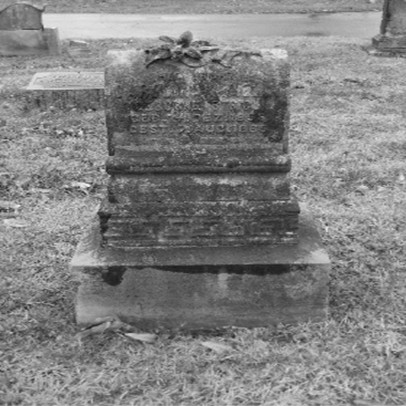
Carolina Striegel Kaelin is buried in St. Michael’s Cemetery, in Louisville, Kentucky.
On March 13, 1898, Louisville learned of Kaelin’s death in the Frankfort penitentiary. It was said that his defense cost him $100,000. His body was brought back to Louisville and he appears to have been interred at St. Michael Cemetery as well, under the first name of Meinrad, rather than Michael.
 Bullets, Bricks and Bourbon