The Murder of Thomas King, 1920
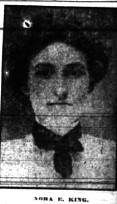
On December 22, 1920, Miss Nora Elderine King and her father, Thomas, aged 70, lived out on Manslick Road, near present day Gagel Avenue. News reports indicated Nora (sometimes spelled Norah) was 33, but according to her later death records, she would have been 42 in 1920. Their house was built 120 years before, around 1800, by Thomas King’s grandfather, a scant few years after Kentucky was admitted as a state. By the time of the Civil War, it was already an old house; by 1920, it was one of the oldest houses in the entire county. In the first quarter of the 1900s, many areas now located within the Louisville city limits were very rural and none of the doors on the King residence even sported a lock, as it would have proved unnecessary when the house was built and for much of its history.

Father and daughter had just finished eating their supper, at about 7:30, and were still sitting at the kitchen table. Nora was facing the window while her father sat with his back to it. Suddenly, a man shoved a pistol through the window pane, breaking it, and pointed the weapon at the pair. To get to that window he had to enter through the chicken yard, as the window looked out into that area. At the man’s command, Nora took the lamp from the table and placed it on the floor. She could only get a glimpse of the intruder’s face in the dim light cast by the lamp. Thomas King leaped up and ran after his pistol, lying on the mantel in a nearby room. The man fled the house, shooting Thomas King as he passed by him running for the door.


The Kings then went out the side door to the home of their closest neighbor, John P. Treitz, a mile away. Treitz was the engineer at the Home for the Aged and Infirm, the Almshouse, and lived about a mile away. Thomas King was taken to the Saints Mary and Elizabeth’s Hospital, where he passed away. (Although the current hospital is very close to where the King home was located, in 1920, the hospital was a considerable distance away, at the intersection of Twelfth and Magnolia streets.)

The next day, there was quick criticism that although the tracks of King’s killer were clearly visible in the soft mud in the chicken yard, there had been no effort by the county police to set bloodhounds on the trail. Captain Harry Kendall, of the county police, however, stated that he and four county patrolmen were in the area and would be returning from the city to continue the search. Farmers nearby, likely concerned due to the horrific crime that occurred so near their homes, took up the search themselves, arming themselves with pistols, rifles and shotguns, and would, it was thought, make quick work of anyone in the least bit suspicious they found. Meanwhile, the city police were actively searching all the bridges, depots, and railroad yards, for the “giant negro man” Nora King described as the assailant.
Arrangements were made to bury Thomas King in the “graveyard of his forefathers.” His body was first taken to Blandford’s Chapel, on South Fourth Avenue, and then at 2 p.m. on December 24, to the King family cemetery, which dated as far back as the house. Although King was the last male descendent in the line and only survived by his daughter, it was expected that the entire countryside would “turn out to pay the heroic old man homage for his courage in the face of death.”
As the murder investigation progressed, it was learned that on the night of the murder, a Mr. Wiser, formerly a park guard who lived beyond Iroquois Park, had seen a man fleeing the scene of the assault. The police learned that Miss King had, the night before, seen the left hand of a man on her bedroom windowsill. A number of suspects were taken before Miss King but she was unable to identify any one of them.
Following the murder, Nora King was staying with the family of Mertin Willett, at 2006 South Fourth Street. (Mr Willett was later buried in the King Family Cemetery, which suggests that he was, in fact, a relative.) A day or so after the murder, it was reported that Miss King, in a “midnight vision” had recalled that the assailant was a man who had “cut corn for her father one day three years ago.” She even recalled his name, Jim Reed. His size, apparently, was an important part in her recollection. She dressed quickly and went to find Mr. Willett, who was a city traffic patrolman, so that she could write it down and not forget it. Patrolmen Charles Stamper and H.W. McDonnel apprehended Reed near his home at 823 South Fourteenth street. The officers had gotten Reed’s address from the Superintendent of the Almshouse, located a short distance north of the King home, where Reed had worked previously. (The Almshouse, officially the Home for the Aged and Infirm, was located near the modern-day intersection of Seventh Street, Dixie Highway and Crums Lane, at the site of the current Southland Terrace.)

As soon as Reed was presented to Miss King at the Willett home, she exclaimed loudly that he was the murderer. The officers cautioned her that it “was a case of life or death” for Reed and she had to be absolutely sure. As she asked him to pose in different ways, Detective Sweeney got him talking and tried to anger him. When he was angered, he “spoke quickly and ran his words together” and Miss King recognized this as a trait of the slayer. She “nodded meaningly[sic] to the detective.” She continued to watch and listen to Reed, although she didn’t say anything to him. She was positive, she emphasized to the police, that he was, in fact, the killer.
Reed admitted that he was the man who had cut corn for her father once and been paid seven cents per shock. He denied, however, having anything to do with the murder. He stated he worked at the Peter-Burghard stone yard at Thirteenth and Maple streets and lived nearby in one of the houses owned by the company. He offered up his neighbors, Rufe Brown and his wife, as alibi witnesses who would know that he was home that night. He claimed he had worked until five o’clock that afternoon, went home, cooked supper and then went to bed about eight. He asked “What kind of trouble is it, what do they say I did?” When told of King’s shooting, he claimed he owned no pistol, only an “old shotgun which had not been loaded for years.”
His alibi witness, Rufe Brown, however, stated he had helped Reed unload coal that day but did not know if Reed was home or not that night. Another witness, a grocery keeper near the stone yard where Reed worked, recalled a strange man who matched Nora King’s description of the attacker come into his store on three successive evenings to get coal oil.
Officers search Reed’s room and found a cap, without a visor, that “might be the cap” Nora King had described as being worn by the slayer. They also found a letter from Reed’s son, who was serving time in the penitentiary for the murder of Will Palmer. Letters indicated that the son “needed money urgently” and Reed was raising small subscriptions (pledges) to be used in some undisclosed venture.
On the morning of December 27, 1920, Detectives McDonnell and Sweeney were sent by Lieutenant Conklin to the murder scene, to see if they could find the assailant’s finger marks on the window sill. If marks or prints were found, they were to send the information to the Indiana Reformatory, in Jeffersonville, as Louisville had no fingerprint expert. It was hoped the marks would confirm or refute the guilt of Jim Reed.
On January 1, 1921, Lige Clark, another suspect arrested by County Patrolman, J.F. Humphrey, in LaGrange, was released when neither Nora King nor another witness, Miss Elizabeth Theobald, could identify him. It transpired that on December 24, just two days after the King murder, Miss Theobald, had been attacked at her home at 131 Galt Avenue, in Crescent Hill, when she’d returned from shopping. The man had held her at gunpoint, ordered her into another room and ordered her to disrobe. Theobald had made a “pretense at complying,” and then “leaped behind a heavy table and gave it a shove.” That knocked the man’s gun from his hand. Miss Theobald spotted a pair of scissors in her work-basket, seized them and threw them at his face. The brave young woman then ran, making it to the front door before him. She ran outside, screaming, and fainted. Neighbors, including Mr. N.C. Blair, who lived at 125, ran to his own door in time to see a man fleeing. He gave chase, along with neighbors, as a posse but was unable to capture the man.
On January 7, 1921, the grand jury refused to indict Reed at the recommendation of the County Attorney, J.M. Chilton, as Nora King had changed her mind about the certainty of her identification.
The Coroner’s inquest was held in early February. One of the jurors, William Roose stated that “Miss King describes the features of a man seen on a dark rainy night better than I would be able to do in daylight.” Treitz and Patrolman I. S. McNeeley testified that King had only stated, before he died, that he had been shot by a negro man.
The police continued to present possible suspects to Miss King. On February 10, she stated that John Johnson, who was picked up prowling in a yard, was not the killer. On February 26, she reported that there were tracks near the house that looked to Miss King like those found after the murder. She had visited the house with Mrs. Treitz, Country Patrolmen Humphrey and Horine reported the prints appeared to be made by an English walking shoe.
George G. King, the victim’s nephew, who lived in Texas, wired $200 as a reward for the arrest of the murderer. It was sent to R. H. Geiger, at 1010 South Third Street, with instructions for the money to be deposited in a Louisville bank.
Almost two years after the murder, in October 1922, it was suggested that George Weick Sr. might have been King’s killer. Weick was the suspected murderer of a man named William Oelke, who was ambushed in the area. Miss King agreed she knew both men, as they had played together and attended the Brown-Austin schoolhouse together some 20 years before. The police were confident that Weick had been a sweetheart of Nora King, which she denied.
A few weeks after the murder, County Patrolman Ed Gartner and City Detectives Fred Gartner (presumably related) and William Daughterty said the King house “was the loneliest and most ghostly house they had ever entered.” A stranger to the area could easily pick out the house where the murder had occurred “from its somber and almost haunted aspect.”
A newspaper article noted:
When a heavy person walks across one of the rooms the planks in the flooring creak and the whole house shakes. When the wind moans through the trees just back of the house, the window panes rattle, the walls creak and groan and the plastering falls to the floor.
The exact location of the old house is now unknown, but the family cemetery still remains in the 4500 block of Manslick Road. Many members of the King and related families lie at rest in the King Family Cemetery. King’s wife, Mary, had died in 1902 and Nora, unmarried, joined her parents in death, on August 29, 1951. She was buried near her parents. In 1979, to accommodate a widening of Manslick Road, the three graves, and those of three others, which were unidentified, were moved farther back in the cemetery plot.

The murder of Thomas King was never solved.
 Bullets, Bricks and Bourbon